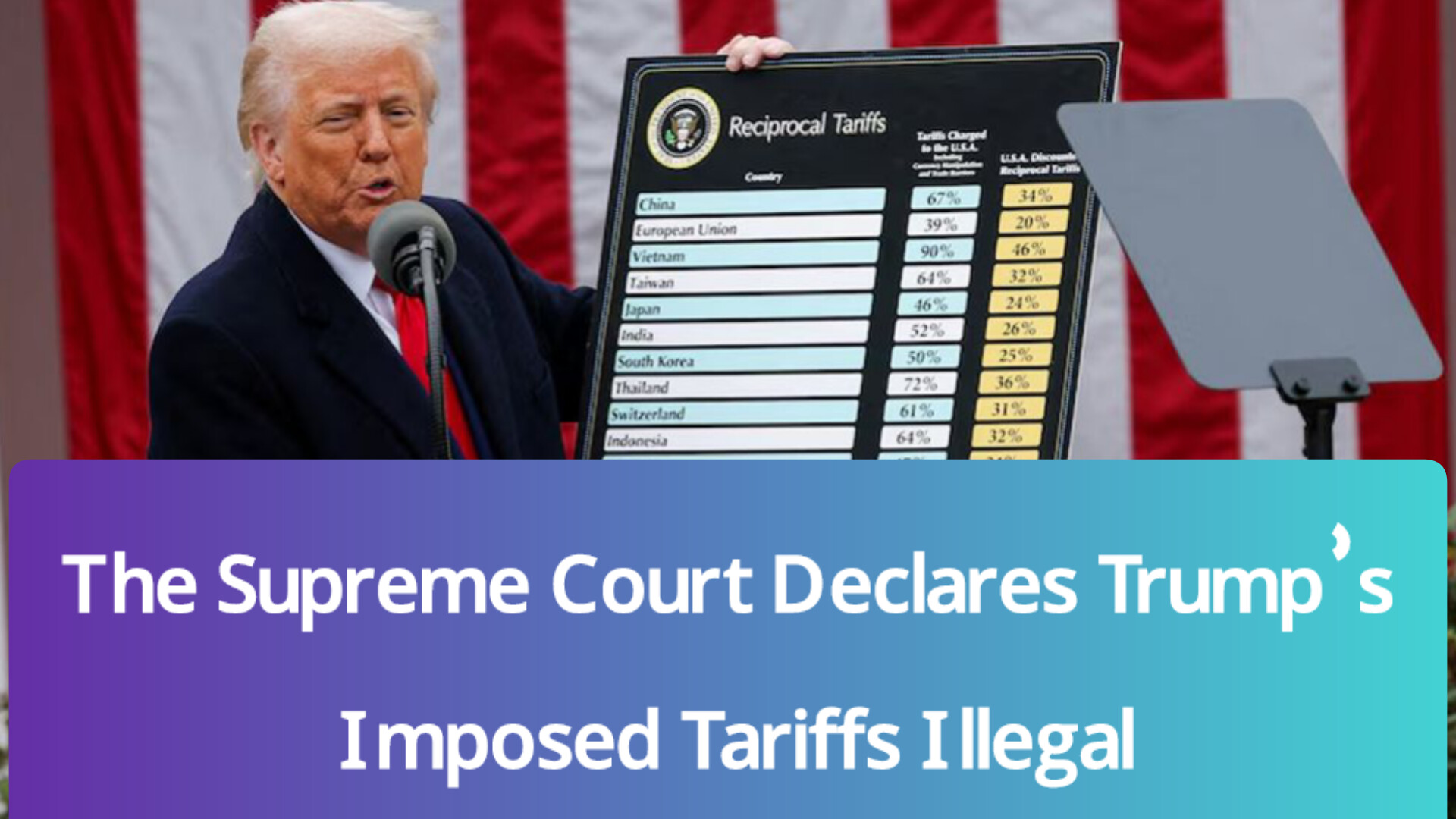
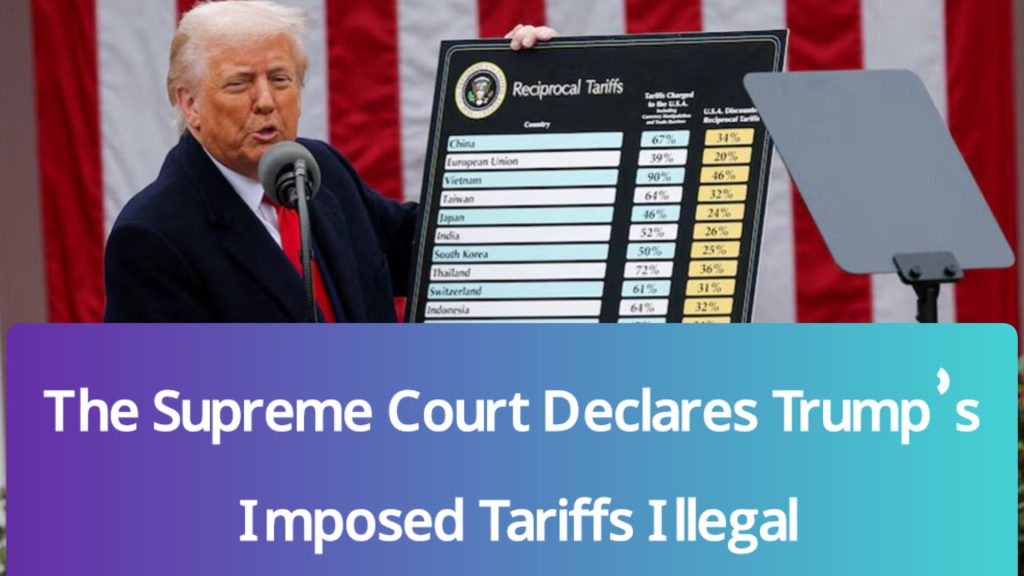
The United States Supreme Court has declared former President Donald Trump’s sweeping tariff policy unlawful, ruling that the administration overstepped its legal authority by imposing broad,
unilateral tariffs on imports from countries around the world. In a decision issued Friday (February 20), the nation’s highest court concluded that the tariffs violated federal law and exceeded the limits of presidential power.
In a 6–3 majority opinion written by Chief Justice John Roberts,
the Court held that the tariff measures breached statutory boundaries. Roberts stated that while the president possesses certain emergency powers, those authorities are not unlimited and must be grounded in clear congressional authorization. The ruling emphasized that Trump’s reliance on national emergency powers to justify widespread tariffs lacked sufficient legal basis.
The Court, however, did not address what would happen to the more than $130 billion in tariffs already collected. It remains unclear whether refunds will be issued, how such repayments would be processed, or what standards would apply to determine eligibility. Legal experts suggest that the ruling could trigger a wave of refund claims from businesses and foreign governments that paid higher duties under the contested policy.
According to the judgment, Trump had invoked the International Emergency Economic Powers Act (IEEPA) to impose tariffs on imports from over 180 countries. The Court clarified that IEEPA does not grant the president the authority to levy tariffs. “IEEPA does not authorize the imposition of tariffs,” the ruling stated unequivocally, underscoring that the statute was designed to regulate economic transactions during genuine national emergencies—not to serve as a blanket justification for broad trade measures.
Justice Brett Kavanaugh filed a dissenting opinion. He argued that the refund process could become legally and economically complicated, especially in cases where businesses had already passed the cost of the tariffs on to consumers. In such situations,
determining who should receive refunds—importers, retailers, or end customers—could prove difficult and contentious.
The majority coalition included Justices Amy Coney Barrett and Neil Gorsuch,
who joined Chief Justice Roberts and the Court’s three liberal justices in ruling against the administration’s actions. In contrast, Justices Clarence Thomas, Samuel Alito, and Kavanaugh dissented.
In April of last year,
Trump announced a wide-ranging tariff program affecting imports from more than 180 countries. The tariffs began at a minimum of 10 percent but reached as high as 49 percent on goods from Cambodia and 48 percent on imports from Laos. Australia faced tariffs of around 10 percent.
At the time, Australian Prime Minister Anthony Albanese criticized the policy as “unjustified” and “not the act of a friend.”
The ruling has generated particular attention in Australia, where businesses are now anticipating substantial refunds. A report by consulting firm EY Australia indicated that if the tariffs are deemed unlawful, the U.S. government could owe more than $1.4 billion to Australian companies alone. Similar claims are expected from other nations and multinational corporations that incurred significant costs due to the trade measures.
The case reached the Supreme Court after a coalition of small businesses and several U.S. states filed joint legal challenges against the tariff regime. They argued that the administration had misused emergency powers to bypass Congress and reshape international trade policy without proper legislative oversight.
In its decision, the Court reaffirmed a fundamental constitutional principle: while the president may act swiftly in times of crisis, such actions must remain within the limits set by Congress.
Roberts wrote that Trump had claimed “extraordinary unilateral authority” to impose tariffs, but such sweeping economic power requires explicit authorization from the legislative branch. The Constitution grants Congress—not the president—the authority to regulate commerce with foreign nations.
The ruling represents a significant rebuke of executive overreach and may reshape the balance of power in U.S. trade policy.
It also sets a clear precedent that emergency economic statutes cannot be stretched beyond their intended scope.
Read more
As businesses prepare potential refund claims and policymakers assess the broader economic impact, the decision marks a pivotal moment in the ongoing debate over presidential authority and the limits of national emergency powers in the United States.